
How to Build a Scalable Onboarding System That Doesn’t Run Through You
If your onboarding process stops when one person gets busy, you do not have an onboarding system. You have an onboarding dependency.
In many organizations, that dependency sits quietly inside HR.
A new employee starts Monday.
HR sends the paperwork. HR schedules orientation. HR explains the systems. HR tracks down the manager. HR reminds someone to provide system access. Then, HR answers the same questions it answered for the last five new hires.
Finally, HR checks in to make sure someone is actually training the employee.
From the outside, the company appears to have an employee onboarding process.
Inside the organization, however, one person, or one small team, is manually holding the entire process together.
At first, this approach may work.
Then the organization grows.
More employees create more onboarding activity. More departments create more role variations. More managers create greater inconsistency. Meanwhile, additional locations, teams, and business units increase the coordination required to move every new employee through the process.
Eventually, HR becomes the single point of failure in a process that directly affects productivity, employee experience, manager effectiveness, and retention.
The problem is not that HR needs to work faster.
The problem is that the organization has not built a scalable onboarding system that can operate without constant human intervention.
Your Employee Onboarding Process May Actually Be a Person
Executives often believe their organization has an onboarding process because new employees successfully make it through their first few weeks.
However, leaders should ask a more important question:
What is actually making the onboarding process work?
Is it the system? Or is it a highly responsible person who remembers everything?
There is a significant difference.
A scalable onboarding system creates consistency through documented workflows, defined responsibilities, repeatable learning resources, and built-in accountability.
A person-dependent onboarding process works because someone knows what needs to happen next.
That person knows who needs an email.
They remember which manager needs a reminder.
They know where the training documents are stored.
They track which employees still need system access.
They remember that the new supervisor should meet with Operations during week two.
They also know who to contact when something goes wrong.
Often, the organization has never formally documented this knowledge.
Instead, the process lives inside someone’s head.
For a while, this approach can feel efficient. In smaller organizations, people communicate quickly. HR knows every manager. Leaders can personally step in when someone misses a step.
Growth changes the equation.
As hiring volume increases, the number of onboarding touchpoints multiplies. Consequently, the process becomes increasingly dependent on memory, emails, spreadsheets, calendar reminders, and follow-up conversations.
What once felt flexible becomes fragile.
The organization has unintentionally created a human-powered onboarding system.
Human-powered systems are difficult to scale.
Why HR Becomes the Single Point of Failure in Onboarding
HR often becomes the onboarding safety net because someone has to protect the new employee experience.
When a manager forgets a step, HR follows up.
When training materials are missing, HR finds them.
If a department lacks a structured training plan, HR tries to help create one.
When employees become confused, HR answers their questions.
Over time, the organization begins relying on HR to compensate for gaps throughout the employee onboarding process.
This dependency creates three significant business problems.
Manual Onboarding Coordination Traps HR in Administrative Work
The more manually HR manages onboarding, the less capacity the function has for strategic work.
Instead of focusing on workforce planning, leadership development, employee retention, culture, and organizational capability, HR spends time coordinating predictable onboarding tasks.
Consider the amount of time required to manually manage a single new employee.
Someone must send information.
Someone must schedule meetings.
Someone must assign training.
Someone must contact the manager.
Someone must confirm system access.
Someone must track completion.
Someone must follow up when tasks are missed.
One new hire may not create a significant burden.
Ten new hires across four departments can.
Thirty new hires across several locations certainly can.
The problem is not the importance of onboarding. Effective employee onboarding is critical.
The problem is the amount of manual effort required to make the process happen.
Executives should pay attention when highly skilled HR professionals spend significant portions of their time reminding managers to complete predictable onboarding activities.
That is rarely a people problem.
Usually, it is a system design problem.
HR Ownership Can Reduce Manager Accountability
When HR becomes responsible for the entire onboarding experience, managers can unintentionally become secondary participants.
They assume HR is handling it.
The employee attends orientation. They receive company information. They complete required training.
From the manager’s perspective, onboarding appears to be underway.
However, organizational onboarding and role integration are not the same thing.
HR can introduce the organization.
HR can explain policies.
HR can coordinate enterprise-wide learning.
However, HR cannot fully teach an employee how success is defined inside a specific role, team, or department.
Managers must own that responsibility.
Unfortunately, many organizations tell managers to “onboard the employee” without defining what effective onboarding requires.
As a result, managers rely on their own experience.
Strong managers may create detailed onboarding plans.
Other managers may schedule a few meetings and expect the employee to learn through observation.
Meanwhile, HR sees the inconsistency and steps in.
Eventually, HR is chasing managers while new employees wait for clarity.
A Manual Onboarding Process Creates an Inconsistent Employee Experience
Person-dependent onboarding also creates inconsistent experiences.
One employee receives a detailed first-week schedule.
Another receives a laptop and a few calendar invitations.
One manager conducts structured 30-day check-ins.
Another assumes the employee will ask questions when they need help.
One department has documented training resources.
Another relies almost entirely on job shadowing.
From an executive perspective, this inconsistency creates organizational risk.
Employees are joining the same company but experiencing very different versions of it.
That difference affects how quickly employees become productive. It affects their confidence. It shapes their perception of leadership.
Ultimately, it may affect whether they stay.
A Scalable Onboarding System Requires Infrastructure, Not Another Checklist
Many organizations respond to onboarding problems by improving orientation.
They update the presentation.
They revise the employee handbook.
Perhaps they add another checklist or create a welcome video.
These improvements may help. However, they do not necessarily solve the underlying problem.
The real question is:
Can your employee onboarding process consistently move a new hire from the first day to a productive contributor without one person manually driving every step?
That requires onboarding infrastructure.
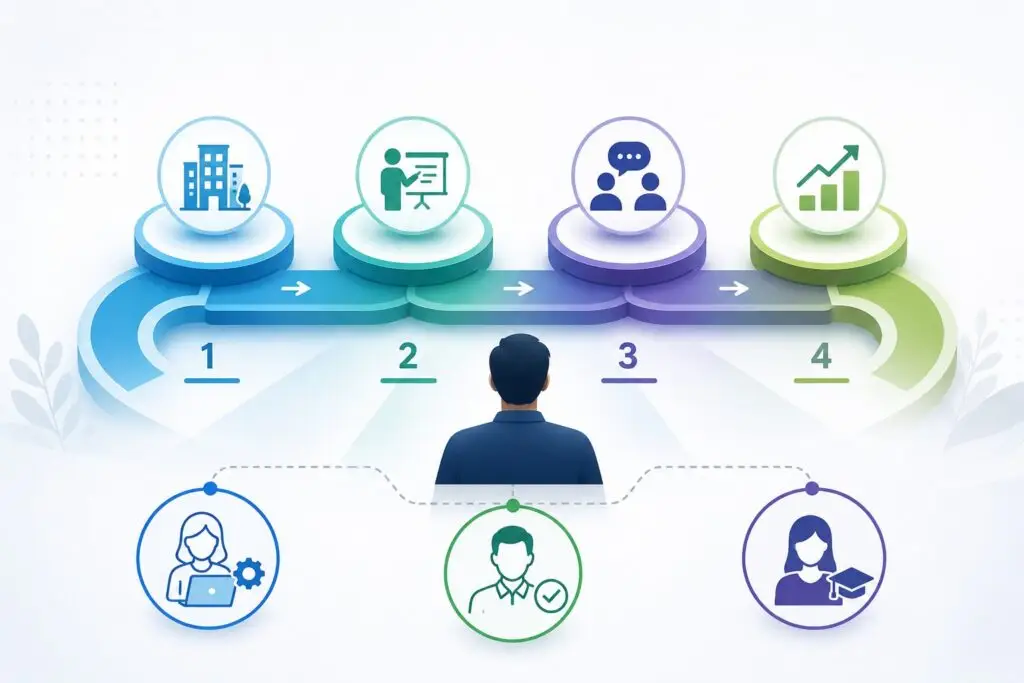
Strong onboarding infrastructure connects four critical elements:
| Onboarding Element | Executive Question |
| Organizational Integration | What does every employee need to understand about the organization? |
| Role Readiness | What must this employee know and be able to do to perform the job? |
| Manager Accountability | What must the manager do during the first 30, 60, and 90 days? |
| System Accountability | How will the organization know the onboarding process is actually happening? |
When these four elements work together, onboarding becomes repeatable.
HR no longer has to carry the process manually.
Managers understand their responsibilities.
Employees know what they are expected to learn.
Additionally, executives gain greater visibility into whether new employees are becoming productive.
The organization moves from coordinating onboarding to operating a scalable onboarding system.
The Four Layers of a Scalable Onboarding System
Executives who want to reduce onboarding dependency should evaluate the process across four layers.
Each layer solves a different part of the scalability problem.
Layer 1: Standardize the Core Employee Onboarding Experience
Every organization has information that should not change based on an employee’s manager or department.
For example, employees may need to understand:
- Organizational mission and purpose
- Culture and values
- Business model
- Customer expectations
- Workplace policies
- Core systems
- Communication expectations
- Compliance requirements
- Organizational structure
- Performance philosophy
The organization should standardize these experiences.
Standardization does not mean removing human interaction.
Instead, it means the organization stops rebuilding the same onboarding experience every time someone joins the company.
Consider what happens when HR repeatedly presents the same information.
The HR leader schedules the meeting.
They prepare the materials.
They deliver the information.
Then, they answer many of the same questions.
A week later, another employee starts.
The process begins again.
Executives should ask whether repeatable information requires repeatable live delivery.
Sometimes it does.
Often, it does not.
A scalable onboarding system can organize foundational information into a structured learning pathway. Employees can receive the right information at the right stage of their onboarding experience.
Then, HR can use human interaction for the conversations that actually require human expertise.
Standardization creates consistency.
More importantly, it protects organizational capacity.
Layer 2: Build Role-Based Onboarding and Learning Paths
Company onboarding tells employees where they work.
Role onboarding teaches employees how to succeed.
This is where many employee onboarding systems begin to break down.
Organizations often create a standard HR orientation but leave job training almost entirely to individual managers.
The result varies significantly.
A scalable onboarding system should identify the knowledge, skills, systems, processes, and performance expectations associated with each major role or role family.
The learning path does not need to document every minute of an employee’s first 90 days.
Instead, it should answer five questions:
- What must the employee understand?
- What must the employee be able to do?
- What systems must the employee learn?
- What decisions must the employee be prepared to make?
- What does competent performance look like?
Once leaders answer those questions, the organization can create a repeatable role-based learning pathway.
For example, a new sales representative may need to understand the company’s customer profile, sales process, product portfolio, CRM expectations, pricing structure, and approval process.
A new operations manager may need to understand staffing models, performance metrics, escalation procedures, compliance requirements, and operational reporting.
The roles are different.
Therefore, the learning paths should be different.
However, the process used to define role readiness should remain consistent.
Managers still coach.
Subject matter experts still teach.
Employees still practice.
Yet, the organization no longer depends on each manager to personally invent the training process.
That is how institutional knowledge begins to become organizational capability.
Layer 3: Build Manager Accountability Into the Onboarding Process
Managers are one of the most important components of successful onboarding.
They are also one of the greatest sources of inconsistency.
Usually, this happens because organizations tell managers to “onboard the employee” without clearly defining what that means.
A scalable onboarding system should identify specific manager responsibilities.
Before the employee starts, the manager may need to confirm equipment, system access, workspace, key meetings, and the employee’s first-week schedule.
During the first week, the manager should clarify role expectations, immediate priorities, communication norms, and key relationships.
During the first 30 days, the manager should review early learning, answer role-specific questions, observe performance, and correct misunderstandings.
During days 31 through 60, the manager should increase responsibility, provide targeted coaching, and assess skill development.
During days 61 through 90, the manager should evaluate role readiness, clarify ongoing development priorities, and establish performance goals.
The manager should not have to remember this process.
The scalable onboarding system should prompt the process.
This distinction matters.
In an informal onboarding process, managers are expected to remember.
In a scalable onboarding system, the process creates the reminder.
The system may prompt a manager to conduct a 30-day conversation.
However, the system should not conduct the conversation.
Technology creates consistency.
Managers provide leadership.
When organizations clearly separate those responsibilities, onboarding becomes easier to scale.
Layer 4: Create Onboarding Visibility and Accountability
Many executives and HR leaders cannot easily answer a basic question:
Is the employee onboarding process actually happening?
They may know an employee attended orientation.
They may know the employee completed compliance training.
However, they often have limited visibility into role training, manager check-ins, skill development, or readiness milestones.
This creates a dangerous assumption.
No complaints are interpreted as progress.
Silence, however, does not necessarily mean the employee is successfully onboarding.
A scalable onboarding system creates visible checkpoints.
Leaders should be able to identify:
- What the employee has completed
- What the employee is currently learning
- Which manager activities have occurred
- Where the employee may be struggling
- Whether required milestones are being met
- Whether the employee is progressing toward role readiness
The goal is not surveillance.
The goal is organizational visibility.
Executives cannot improve a process they cannot see.
More importantly, leaders should not discover onboarding problems after an employee resigns.
Stop Building Employee Onboarding Around Your Most Responsible Person
Most organizations have someone who keeps onboarding moving.
They are organized.
They care about the employee experience.
They remember details.
They follow up.
They solve problems before senior leaders even know those problems exist.
These employees are incredibly valuable.
However, they can also unintentionally hide broken systems.
Because they compensate so effectively, the organization may not realize how fragile the onboarding process has become.
Executives should ask a difficult question:
What happens to onboarding if this person is unavailable for 30 days?
Would managers know what to do?
Would new employees receive the correct information?
Would training continue?
Would someone know which tasks had been completed?
Would leaders know where employees were in the onboarding process?
If the answer involves confusion, missed steps, delayed training, or managers asking, “What are we supposed to do?” the organization has identified a scalability problem.
The goal is not to make a valuable HR employee less important.
The goal is to stop requiring that employee to personally hold the entire process together.
High-performing employees should improve systems.
They should not have to become the system.
Use the 30-Day Absence Test to Evaluate Your Onboarding System
Executives can quickly evaluate onboarding dependency with one simple exercise.
Imagine the person most responsible for onboarding is unexpectedly unavailable for 30 days.
Then ask:
- Would new employees still know what to do?
- Would managers know their responsibilities?
- Would required training still occur?
- Would role-specific learning continue?
- Would leadership know whether employees were progressing?
- Would anyone know what step comes next?
If the onboarding process immediately becomes inconsistent, the organization does not yet have scalable onboarding infrastructure.
It has tribal knowledge.
This test also applies beyond employee onboarding.
In fact, executives can use it to identify operational dependency throughout the organization.
Whenever a critical process relies heavily on one person’s memory, relationships, or personal follow-up, the organization has created a single point of failure.
Growth eventually exposes those dependencies.
What a Scalable Employee Onboarding System Looks Like in Practice
Consider a growing organization that hires employees across multiple departments.
In a manual onboarding environment, HR receives a hiring notification and begins coordinating.
Emails are sent.
Calendars are checked.
Managers are contacted.
Training documents are gathered.
System access is requested.
Orientation is scheduled.
Follow-up reminders are created.
The process works because HR keeps pushing it forward.
Now consider the same organization with a scalable onboarding system.
The employee’s role triggers a defined onboarding pathway.
The employee receives standardized organizational onboarding.
The manager receives a clear onboarding roadmap with required activities and checkpoints.
Role-specific learning resources are assigned.
Key subject matter experts are identified.
30, 60, and 90-day milestones are defined.
Progress becomes visible.
Exceptions still require human judgment.
Coaching still requires managers.
Relationships still matter.
However, predictable activities no longer require constant manual coordination.
That is the distinction executives need to understand.
Automation does not replace the human side of employee onboarding.
It protects it.
When HR and managers spend less time coordinating predictable tasks, they gain more time for conversations, coaching, feedback, and employee development.
The goal is not less human interaction.
The goal is better human interaction.
Decide What Should Be Human and What Your Onboarding System Should Manage
Not every part of onboarding should be automated.
The goal is not to turn a new employee’s first 90 days into a series of automated emails and online courses.
That simply creates a different problem.
Instead, executives must decide which activities require human judgment and which activities require consistency.
A useful decision process evaluates each onboarding activity using three questions.
Does This Onboarding Activity Happen Repeatedly?
If the organization performs the same activity for nearly every new employee, leaders should consider standardizing it.
For example, employees may repeatedly need information about company history, policies, communication expectations, or core systems.
HR should not necessarily recreate or manually coordinate those experiences for every employee.
Does the Activity Require Judgment, Coaching, or Relationship Building?
If the answer is yes, the activity should remain human-led.
Managers should discuss performance expectations.
Leaders should explain strategic priorities.
Coaches should provide feedback.
Team members should build relationships.
A scalable onboarding system creates space for these interactions by reducing unnecessary coordination.
Does the Process Depend on Someone Remembering?
If the answer is yes, the system should create the trigger, reminder, or accountability mechanism.
For example, a system can remind a manager to conduct a 30-day conversation.
The system should not conduct the conversation.
A learning platform can deliver foundational product knowledge.
The platform should not replace role-specific coaching.
A workflow can assign training resources.
The workflow should not determine whether an employee is ready for greater responsibility.
The best onboarding systems create structure around human leadership.
They do not attempt to replace it.
The Executive Questions That Reveal Onboarding Dependency
If onboarding feels exhausting, inconsistent, or overly dependent on HR, the solution is rarely another checklist.
Executives should examine the infrastructure.
Ask:
- Where does our onboarding process depend on one person’s memory?
- What information does HR repeatedly explain?
- Which onboarding activities require constant follow-up?
- What responsibilities do managers believe HR owns?
- What responsibilities does HR believe managers own?
- How have we defined role readiness?
- How do we know whether a new employee is progressing?
- Which onboarding activities could continue without manual coordination?
- What would break if our onboarding lead disappeared for 30 days?
These questions shift the conversation.
The issue is no longer:
How can HR manage onboarding more efficiently?
Instead, the question becomes:
How should we design a scalable onboarding system so HR does not have to manually manage every employee through the process?
That is an executive-level question.
A Scalable Onboarding System Turns Knowledge Into Organizational Capability
As companies grow, leaders eventually discover that many processes cannot continue operating the way they did when the organization was smaller.
Employee onboarding is one of those processes.
The informal conversations that once worked become inconsistent.
The personal follow-up that once felt manageable becomes exhausting.
The experienced employee who knew everything becomes a bottleneck.
The HR leader who could personally oversee every new hire becomes overwhelmed.
This does not mean the organization has bad people.
It means the organization has outgrown a person-dependent process.
Scalable companies intentionally convert important knowledge and repeatable activities into organizational capability.
They document what matters.
They clarify ownership.
They create repeatable learning pathways.
They build accountability into the process.
Additionally, they use systems to support human leadership.
Most importantly, they stop requiring one person to carry the operational weight of onboarding.
If Your Onboarding Process Runs Through One Person, Growth Will Eventually Expose It
Your onboarding process may appear to work today.
Employees are starting.
Managers are receiving reminders.
Training is happening.
Problems are being solved.
However, executives should look beneath the activity.
Who is making all of it happen?
If the answer is one highly committed HR leader, coordinator, trainer, or operations employee, the organization has a dependency that growth will eventually expose.
The solution is not another checklist.
The solution is not asking HR to become more organized.
Furthermore, the solution is not adding more manual follow-up.
The solution is to build a scalable onboarding system that clearly defines what employees learn, what managers own, what the system manages, and how leadership measures progress.
Because onboarding should be supported by HR.
It should be led by managers.
But it should be powered by a system.
Is Your Employee Onboarding Process Built to Scale?
If your HR team is manually coordinating every new hire, repeatedly chasing managers, and carrying the operational burden of onboarding, it may be time to examine the system behind the process.
A strategy conversation can help identify where onboarding dependency exists, what should be standardized, and how to build a scalable onboarding system that supports growth without creating another administrative burden.
Schedule a strategy conversation with our team to evaluate whether your onboarding process is built to scale. Schedule Meeting